

The Positioning Flywheel™
A proprietary methodology by Motif Brands built for founder-led businesses navigating brand transformation.
Most brands aren’t under-marketed. They’re psychologically misaligned. This is the framework that fixes that.
Why Positioning Usually Fails
Most work on positioning treats brand like a communication problem. Fix the logo, run more ads,refresh the website, etc.. These are real brand elements, but none of them address why an audience hasn’t fully committed, which is always a psychological gap, not a visual one.
Linear brand models assume audiences move in a straight line from awareness to loyalty. Unfortunately, it’s not so easy. The brands that dominate their categories aren’t louder or better-designed than their competitors. Their brand positioning has compounded to a point where they’ve accumulated flywheel momentum that competitors can’t replicate with tactics.
The Positioning Flywheel™ was built around how audiences actually form trust, assign meaning, and choose brands.
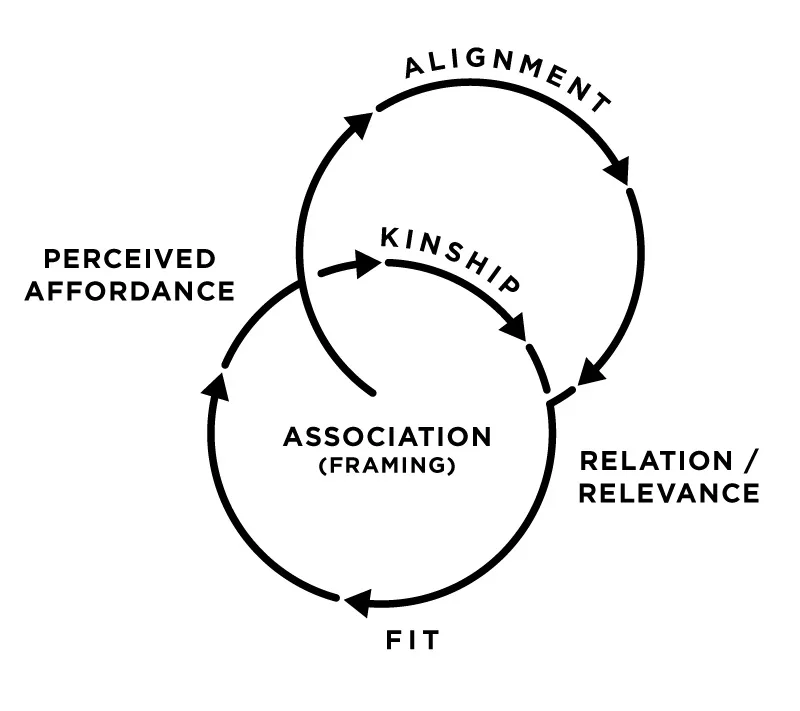
The Six Stages
1) Association: Framing
Audiences form judgments before a single word is read. The visual cues, the language, and the people a brand surrounds itself with are all positioning decisions. Framing tells the audience what category you are before they’ve decided whether they care.
Most brands frame themselves accidentally or submit to the industry. The signals they send are inconsistent, inherited from a previous version of the business, or borrowed from competitors. Deliberate framing is where transformation begins.
The Stalling Symptom: Your audience understands what you do but can’t articulate why you’re different.
2) Alignment
Once the framing lands, the audience tests it against their own worldview and beliefs. Does this brand see things the way I do? Does it understand my standards, my pressures, my definition of excellence? Alignment isn’t about shared demographics, it’s about shared values and point of view (POV).
This is where storytelling, philosophy, and the brand’s position on things that matter create signal. The audience isn’t just evaluating your capabilities. They’re deciding whether you’re worth trusting.
The Stalling Symptom: Prospects engage with your content but hesitate to move forward. They like you, but they’re not sure they trust you.
3) Relation / Relevance
Alignment determines whether the brand resonates. Relation determines whether it matters to this specific person, at this specific moment. It’s a hierarchical assessment: the stronger the alignment, the more the audience elevates the brand’s relevance to their situation.
For a founder navigating growth, relation feels like: this brand understands my specific pressure. Not just business challenges in general, but actually my challenge. That level of specificity is what converts interest into consideration and intention.
The Stalling Symptom: You’re winning referrals within a tight circle but not expanding beyond it. Relevance is strong inside a tribe, invisible outside it.
4) Fit
As relation deepens, the audience begins assessing fit. Not just whether the brand is good, but whether it’s right for them, right now. This is where practical questions emerge: Can this partner close the gap I need to close? Does the timing work? What does the relationship look like in 90 days, one year, three years?
Fit is the threshold between consideration and commitment. Brands that reach Fit are relevant. The ones that fail here are relevant but not chosen. This is survival of the fittest.
The Stalling Symptom: You’re consistently in the final two but losing deals you expected to win. The decision feels arbitrary. It isn’t.
5) Perceived Affordance
When Fit is established, something shifts. The audience stops evaluating the brand and starts imagining what becomes possible because of it. Perceived Affordance is the moment they can see themselves achieving something they couldn’t achieve alone, not just functionally, but institutionally and personally. What does the brand empower them to do? Or better yet… Who does it empower them to become
This is where psychological utility replaces functional utility. The product or service is no longer a tool. It’s a means of becoming.
The Stalling Symptom: Clients are happy with outcomes but don’t talk about the relationship in transformative terms. They describe results, not what the partnership made possible.
6) Kin
Kinship is the deepest stage. The audience no longer sees the brand as a vendor or even a partner. It’s an extension of their own identity, embedded in how they see themselves and their work. The brand becomes part of their story and internal narrative.
A brand that achieves Kinship compounds. Kinship deepens over time through shared problems solved, standards raised, and meaning made together. These clients don’t leave. They advocate and become inseparable from the brand’s story.
The Stalling Symptom: Strong client relationships that don’t convert to long-term retainers, referrals, or deeper engagements. The relationship ends at the transaction.
The Loop: Why It Compounds
This isn't a funnel. It's a flywheel.
A funnel ends. A flywheel accelerates.
Kinship isn’t the conclusion of the positioning process. It’s the point at which the cycle restarts at a higher level. A brand that has earned Kinship carries that trust into a new cycle of Association, but now it frames from a position of established credibility. Every stage moves faster, every signal resonates more, and the audience doesn’t need to be convinced. They already believe.
This is why category-defining brands can reinvent without losing their audience. They’re not starting over. They’re cycling with momentum and it’s why brands that plateau at Fit never compound, but are doomed to just replace customers indefinitely.
Applied Across Contexts
The Same Psychology. Different Terrain.
The Positioning Flywheel™ isn’t category-specific. This is possible because the psychological process it maps (how humans form trust, assign meaning, and choose a brand as their own) operates the same way whether the audience is a hospital executive evaluating a performance partner, a homeowner choosing a craftsman for a generational renovation, or a consumer anchoring their identity through what they wear.
The framework adapts to the context. The underlying mechanics don’t change.
B2B Corporate & Institutional Rebranding: A regional healthcare performance consultancy needed hospital executives to stop evaluating them as a vendor and start considering them as a transformation partner. The Flywheel mapped exactly where the relationship was stalling and what needed to shift at each stage to move the executive from interest to institutional commitment.
High-End Trade, Craft & Service Positioning: A glass studio with deep craft and zero brand language was invisible to the design-build clients who would have valued them most. The Flywheel identified the framing gap and rebuilt the brand’s signals from the association stage forward so the right clients recognized themselves immediately.
B2C Premium & Identity Brand Repositioning: A jewelry brand built Relation without Fit. Customers loved the product but didn’t see it as central to who they were. Repositioning the brand around identity (not product) moved customers from appreciation to Kinship.
Where Brands Stall
Where are you on the flywheel?
Most founder-led brands plateau at FIT. They're relevant, They're capable. Their clients are satisfied. But they're not resonant. Not sought out. Not compounding. The gap between FIT and KINSHIP has a name. It has measurable symptoms. And it has a fix — but only if you can accurately locate where the breakdown is.
That's what the Brand Deficit™ Scorecard is built to do.